Client
Side project
Industries
Tag 1, tag 2, tag 3…
Date
Month YYYY
This fictitious project aims to improve the adoption process for dogs by designing a user-friendly website that facilitates matchmaking between potential pet owners and rescue pups.
The goal is to create an enjoyable journey for adopters, ensuring they find a dog perfectly suited to their lifestyle. The following made-up KPIs were established to lead the assignment.
Reduce the average time for adopters to find their match by 25% within the first year.
Maintain a 90% accuracy rate in matching adopters with suitable pets based on lifestyle preferences.
Encourage repeat adoption with a 15% increase in returning users adopting additional pets within the first year.
As a UX designer, my role and intention was to showcase the design process, methodologies, and skillset to achieve the given project objectives.
Design & Prototyping: Figma
User Research: Google Docs, Google Sheets
The methodology followed, based on the double diamond design process, started with the discovery phase. After the research activities performed the main problems detected were:
Limited Choice: Many people prefer acquiring pets over adoption due to limited animal stock and breed preferences.
Lack of Identification/Uncertainty: Potential adopters are unsure if a particular animal fits their lifestyle.
Lack of Connection: Adopters feel the need to understand the background and conditions of the animals they adopt.
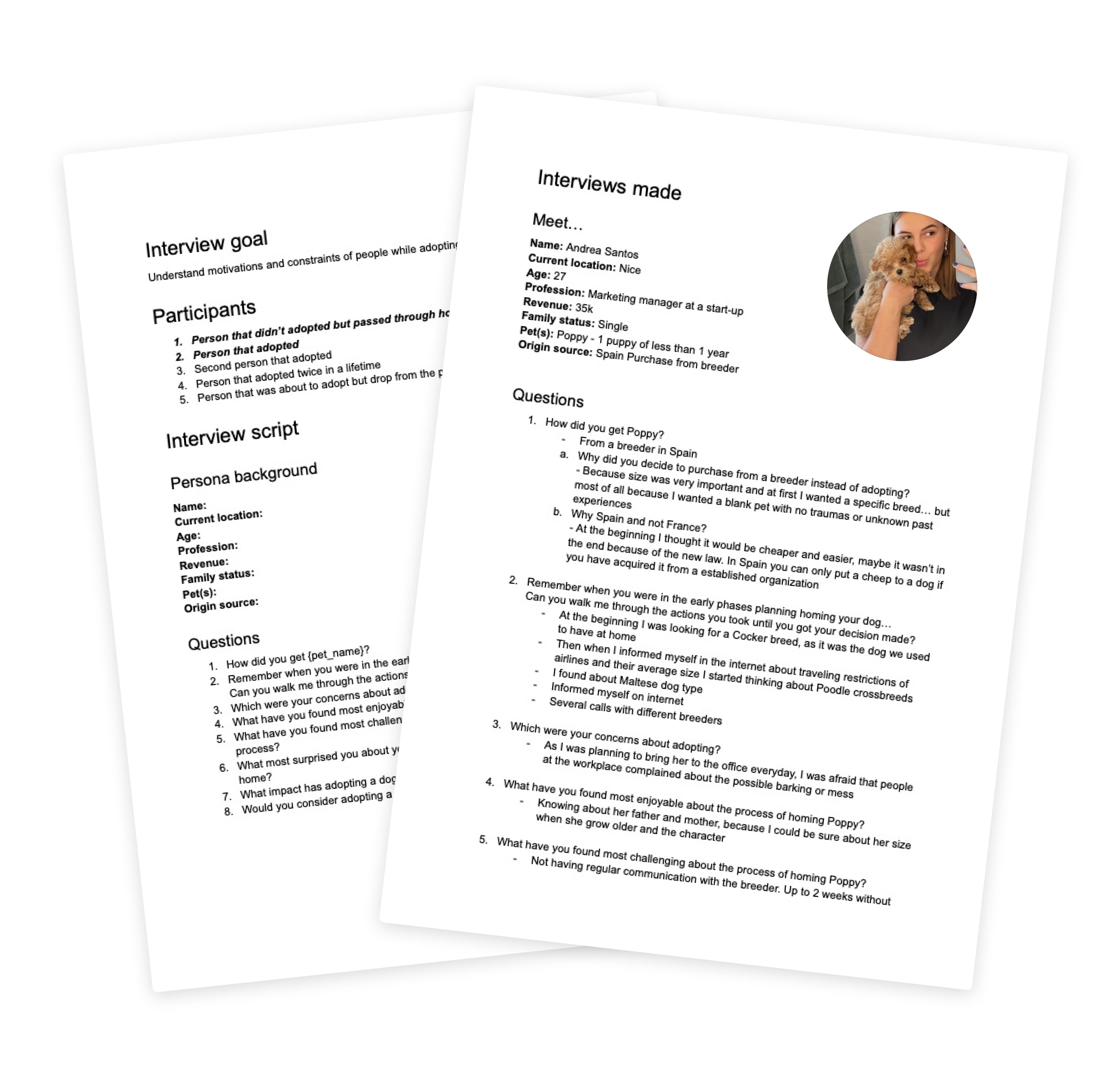
From all the possible research activities I decided to start with some user interviews to empathize with the end problem and understand better what was important for the targeted personas.
I conducted interviews with various participants including recent dog adopters, those who adopted multiple times, and those who considered but did not adopt.
The questions focused on understanding their adoption journey, concerns, joys, challenges, surprises, and impacts on their lives.
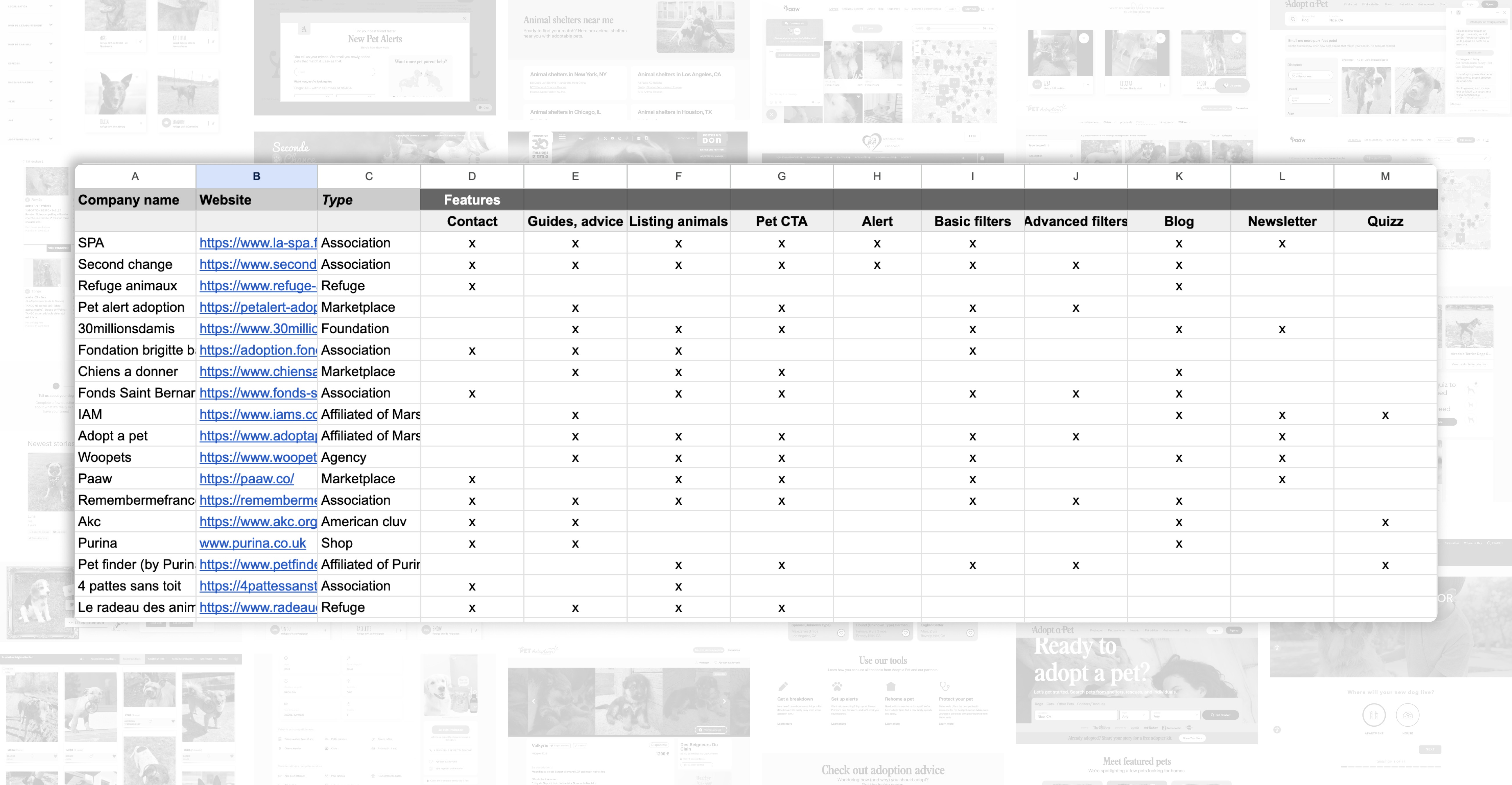
Analyzed competitors, both direct and indirect, to identify existing adoption solutions, their features and user experiences. With that I had a better idea on the basic features and pages the site might need to have. Some of the problems detected are highlighted below:
Refuges’ websites have a more deteriorated UX, lack of filters for different breeds / dog types. Their focus is on explaining more about the refuge itself than the animals they are for adoption given the mixed breeds and conditions. Most of them were foundations or individuals’ websites.
On certain websites the animal call to action is often a simple phone / email within the description, which makes difficult to track metrics
Some of the possible detected features solutions on other indirect marketplaces were:
Pet alert or partnerships/aggregation of other sites for when the desired stock is not available
Images and video of the pet are key for a first connection with the given animal, but adopters are drawn by certain breeds’ characters
A personal quiz that ask for certain information to match the adopter lifestyle and preferences with a suitable dog regardless the above
A call to action in the shape of a form, so we can track and measure user interaction onsite
Possibility to contact with experts, like vets and educators, that can reinforce trust on adoption and reply given questions without being directly the refuge owners
Stories about people that adopted that reinforce the choice of adoption
After the brainstorming of functionalities, I did a prioritization based on the KIPs as main pillars. In different phases they could be all accomplished, but based on feasibility and importance I started wireframing the key touchpoints. After having the sitemap and user flows I started with the high fidelity prototypes, establishing a design style that was both user friendly and scalable. Below are a few highlighted screens.
By implementing user-centered design principles and incorporating insights from research, the proposed solution aims to enhance the adoption experience for both new and recurring adopters. This exercise allowed me to follow through all the design phases, from the Discovery to the Delivery of a pleasant user journey. Without the constraints of a real company I was able to expand my design skills on a desirable user interface that matches both aesthetics and functionality with user centered design as a whole.